The practical planning path · lesson 4 of 7
4. Keep power separate from daily energy
Watts describe a rate; watt-hours describe accumulated energy.
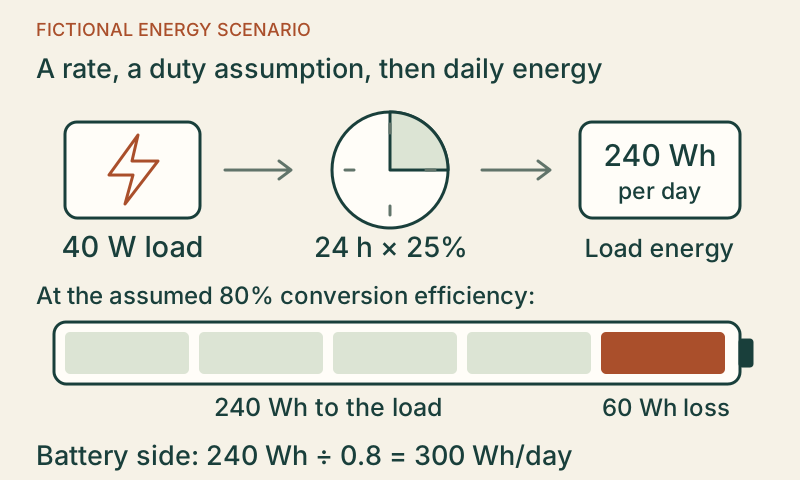
- 40W × 24h × 25% = 240Wh
- 240Wh ÷ 0.8 = 300Wh
- Battery-side daily assumption
Original worked-example diagram reproducing explicit lesson inputs, not a tested product runtime. Efficiency, usable storage, missing loads and charging assumptions remain separate.
For an explicit scenario,watts × operating hours × duty fraction gives load energy. Running loads that overlap contribute to concurrent power. Starting demand is another question. Battery-side energy also depends on conversion losses; usable battery storage is not necessarily nominal storage. Manufacturer lab references describe their test context,not every temperature,setpoint or travel pattern. Solar and other charging need separate availability assumptions.
Worked example
Fictional inputs,not a product promise:40W for24 hours at25% duty uses240Wh/day at the load. At80% total conversion efficiency,the battery supplies300Wh/day. A1000Wh nominal battery with80% assumed usable energy has800Wh usable; no-charging arithmetic is about2.67 days. Aging,temperature,reserves and missing loads can change that result.
Read the explanation without JavaScript
240Wh ÷0.8 =300Wh. This is a scenario result,not a tested runtime or wiring approval.
Free next steps
Try a saved energy scenario · Use free unit explanations
Continue: 5. Budget water between stopsSources and boundary
- ICECO VL45 single-zone refrigerator, variant37288011595943 · observed 2026-11-07
Original lesson reviewed2026-11-07. Examples are clearly identified above; no example input becomes a catalog fact. Learning checks do not award installation qualifications or certify competence. Lessons and continuation are free; no purchase,account or answer storage is required.