The practical planning path · lesson 1 of 7
1. Write down the exact vehicle
A nameplate family is a starting point,not a complete fitment scope.
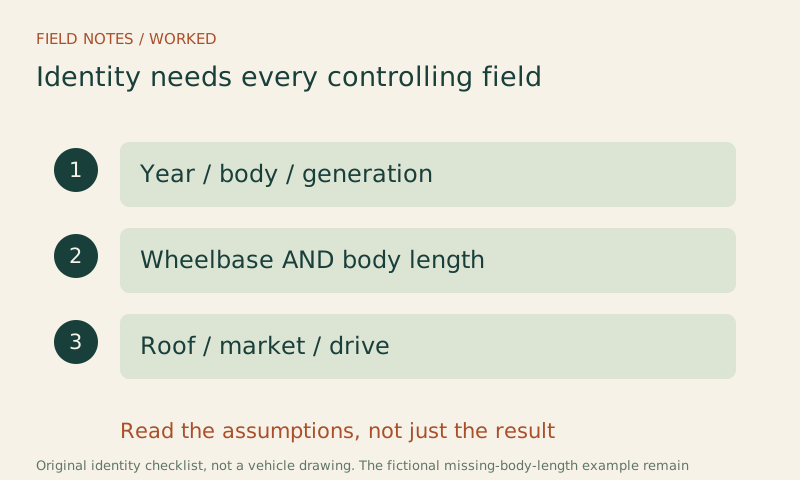
- Year / body / generation
- Wheelbase AND body length
- Roof / market / drive
Original identity checklist, not a vehicle drawing. The fictional missing-body-length example remains unresolved;170in alone does not identify the pilot.
A Sprinter can differ by generation,year,market,wheelbase,body length,roof and drive configuration. Record those fields from the actual vehicle documents. Then record the part’s exact model,revision,side and position. A range of advertised model years does not establish every possible combination. Our pilot is deliberately one2025 US Cargo907/VS30,170-inch standard-length high-roof RWD configuration.
Worked example
Fictional buying note: you have a170-inch van but have not checked whether it is extended. The current pilot explicitly excludes extended body. Your unknown body field remains unresolved; selecting the pilot is a research context,not vehicle identification.
Read the explanation without JavaScript
A missing controlling field remains unknown. Similar family names or one matching dimension do not create a reviewed combination.
Free next steps
Inspect all pilot fields · Use the task-first chooser
Continue: 2. Measure the right dimensional basisSources and boundary
- Mercedes-Benz Body and Equipment Guideline Sprinter BM907, edition2025-6 · observed 2026-11-07
Original lesson reviewed2026-11-07. Examples are clearly identified above; no example input becomes a catalog fact. Learning checks do not award installation qualifications or certify competence. Lessons and continuation are free; no purchase,account or answer storage is required.