The practical planning path · lesson 6 of 7
6. Track mass and independent limits
A positive gross margin does not establish axle or roof compliance.
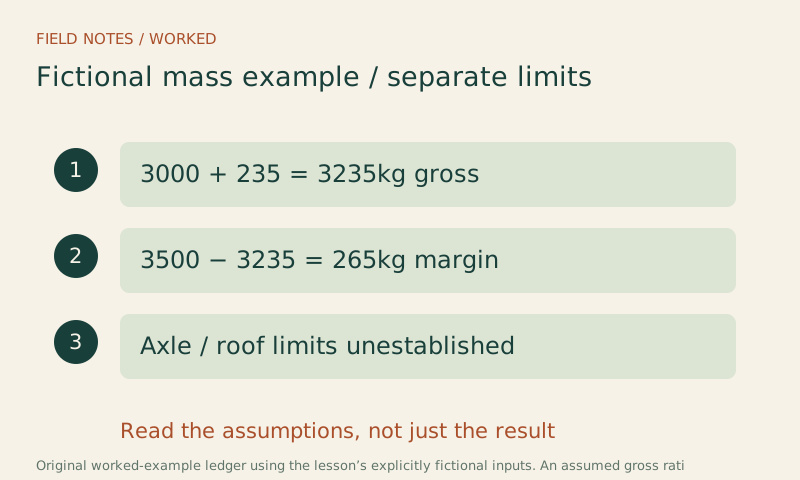
- 3000 + 235 = 3235kg gross
- 3500 − 3235 = 265kg margin
- Axle / roof limits unestablished
Original worked-example ledger using the lesson’s explicitly fictional inputs. An assumed gross rating and arithmetic margin do not approve axle, roof or mounting loads.
Start with the actual vehicle’s measured mass and document what was on the scale. Add only equipment,people,contents and cargo not already included. Keep dry equipment mass separate from shipping weight and wet contents. The exact vehicle plate,axle/tire limits and applicable roof/rack/mounting limits have different scopes. Static and dynamic roof ratings are not interchangeable; gross mass alone cannot locate loads across axles.
Worked example
Fictional inputs:3000kg measured baseline +140kg passengers +50kg additional fluids +20kg gear +25kg new equipment =3235kg. Against an assumed3500kg exact gross rating,the arithmetic margin is265kg. No front/rear load distribution or roof capacity was established. Counting equipment already present at the weighing again would distort the result.
Read the explanation without JavaScript
The sum does not encode placement or axle distribution. Exact ratings and completed-vehicle weighing remain necessary evidence.
Free next steps
Use the mass/limit scenario · Keep documentation prerequisites
Continue: 7. Read the source before the headlineSources and boundary
- Mercedes-Benz Body and Equipment Guideline Sprinter BM907, edition2025-6 · observed 2026-11-07
Original lesson reviewed2026-11-07. Examples are clearly identified above; no example input becomes a catalog fact. Learning checks do not award installation qualifications or certify competence. Lessons and continuation are free; no purchase,account or answer storage is required.